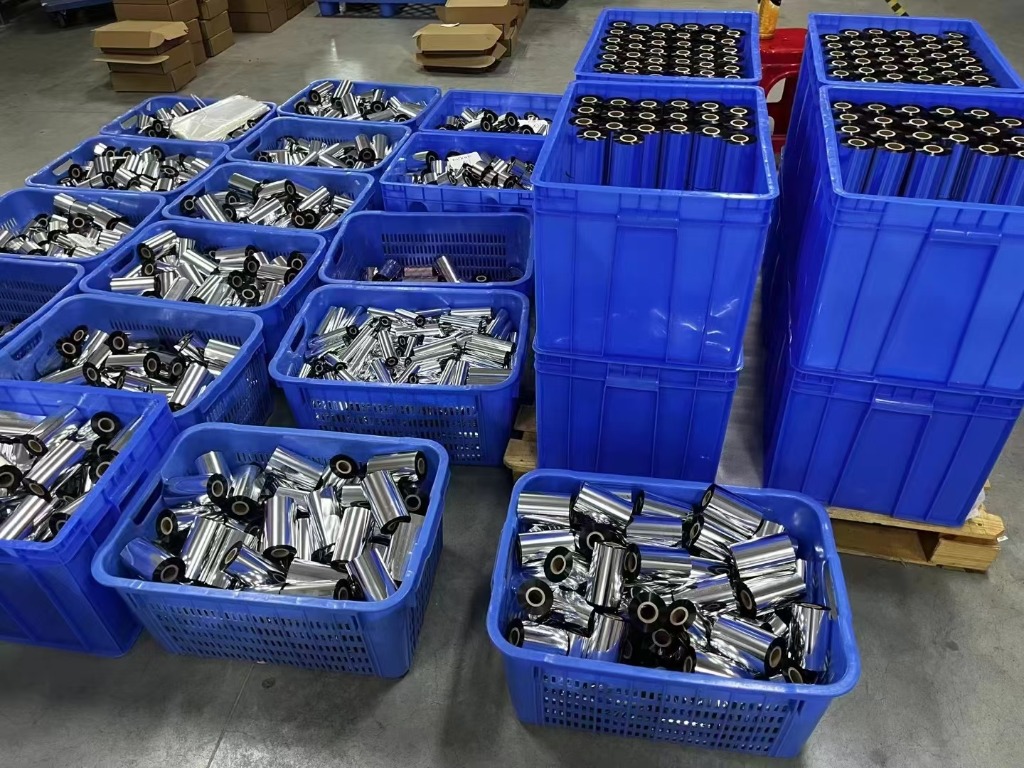
Procuring wax-resin ribbon jumbo rolls affects slitting yield, finished-roll consistency, inventory exposure, and customer print performance. A sound sourcing process therefore evaluates the material, the converting plan, and the evidence supplied with each lot—not only the price per square metre.
YHYA is a thermal transfer ribbon supplier and finished-roll converter. This guide describes industry coating and jumbo-roll practices to help buyers prepare specifications and qualification trials; it does not imply that YHYA owns the upstream coating process.
What Is a Wax-Resin Ribbon Jumbo Roll?
Thermal transfer ribbon coating plants apply an ink layer and backcoat to a polyester carrier film, then wind the coated web into wide master or jumbo rolls. Downstream converters slit and rewind these jumbos into finished rolls for barcode printers and coding equipment.
Wax-resin grades are formulated to balance print sensitivity with stronger rub and smear resistance than general-purpose wax grades. Actual performance depends on the exact formulation, label surface, printer, and settings, so the category name alone is not an acceptance specification.
Before requesting a quote, define:
- Jumbo format: usable width, wound length or diameter, core dimensions, winding direction, splice policy, and maximum handling weight;
- Finished-roll plan: target widths, lengths, cores, notches, ink side, and expected yield assumptions;
- Print application: printer and printhead type, label face stock, barcode and text requirements, and production settings;
- Durability needs: rub, scratch, moisture, chemical, or temperature exposure and the test method for each;
- Packing and logistics: support method, moisture protection, pallet or crate requirements, and transport route; and
- Documentation: technical data, safety information, declarations, lot identification, and change-notification expectations.
Separate Material Qualification From Converting Qualification
A jumbo roll can print well but convert poorly, or convert cleanly but fail the customer’s label application. Treat these as related but distinct approval tracks.
Material Qualification
Print the candidate ribbon on the intended face stocks and printers. Establish a usable energy-and-speed window, verify barcodes where required, and run repeatable resistance tests based on the end use. Record the sample lot and all test conditions.
Review the backcoat, transfer behavior, coating uniformity, and any available conformance or restricted-substance documentation. Where a property is important, ask for the test method and sampling basis rather than relying on a descriptive claim.
Converting Qualification
Run the material on the intended slitter-rewinder and evaluate tracking, edge condition, static behavior, winding, splice handling, and usable yield. Convert representative narrow and wide finished rolls, because a single convenient layout may not reveal all handling issues.
Approve the jumbo specification and the finished-roll specification separately. This makes it easier to identify whether a later issue arose in the source material, the slitting plan, or the finished-roll configuration.
Where Low Unit Prices Can Hide Cost
Price comparisons can omit costs that appear only after conversion:
- Variable transfer or density: may require repeated printer adjustments or create barcode defects on customer labels.
- Edge or winding defects: may reduce usable width, interrupt the slitter, or create unstable finished rolls.
- Unexpected splices: may increase downtime and complicate yield accounting if their number and marking are not agreed in advance.
- Poor transport support: may allow core damage, pressure marks, moisture exposure, or telescoping before the jumbo reaches the converter.
- Weak lot traceability: makes investigation and containment slower when a customer reports a print issue.
- Uncontrolled material changes: can invalidate earlier qualification even when the commercial grade name remains unchanged.
Compare total usable output and qualification risk, not just invoiced area.
Jumbo-Roll Decision Matrix
| Decision area | Evidence to request | Converter risk addressed |
|---|---|---|
| Ribbon grade | Technical data plus production-label print trials | Mismatched transfer and durability |
| Coating consistency | Supplier test records with named methods | Density variation and print voids |
| Jumbo construction | Approved dimensions, core, winding, and splice specification | Loading and yield surprises |
| Slitting behavior | Converter trial across representative layouts | Edge defects, static, and web breaks |
| Packing | Agreed support and protection drawing or sample | Transit damage and roll deformation |
| Traceability | Lot identifiers linked to documents and shipment | Slow containment and root-cause review |
| Change control | Written notification terms | Unplanned requalification |
Numerical limits belong in an agreed specification only when the supplier and buyer share the measurement method, sampling plan, and acceptance rule.
Purchase Specification Checklist
Before approving a jumbo order, confirm:
- ribbon grade and revision or supplier reference;
- carrier and coating construction as documented by the supplier;
- usable coated width and agreed edge-trim treatment;
- wound length or diameter and the applicable measurement method;
- core material, inside diameter, length, and drive or notch details;
- ink side, unwind direction, and roll orientation;
- permitted splice count, type, location rules, and marking;
- winding and roll-appearance acceptance criteria;
- lot identification and documents supplied with the shipment;
- packaging, support, pallet or crate, and moisture-protection requirements; and
- change-notification and nonconformance process.
Avoid generic values copied from another jumbo program. The appropriate dimensions and handling limits depend on the converter’s equipment and material flow.
Planning Slitting Yield
Start with the usable coated width stated in the approved jumbo specification. Build layouts using the finished-roll widths, required trim, blade or spacer arrangement, and any lanes intentionally left unused. Then account for trial material, splices, roll changes, and agreed quality losses.
Use a documented yield formula so procurement and operations compare supplier quotes on the same basis. After the qualification run, replace assumptions with measured conversion data. A wider jumbo is advantageous only when the slitter can handle it safely and the order mix uses the additional width efficiently.
For finished rolls rather than jumbo material, review the wax-resin ribbon series. Related planning resources include anti-static backcoating and printhead care, slitting tolerance and tension control, and the label and ribbon compatibility guide.
Documentation and Compliance Review
Regulatory language should match the exact supplied material and intended market.
- RoHS: Review the current scope and supplier declaration against the applicable European Commission RoHS framework.
- REACH: Ask what the supplier declaration covers and how candidate-list updates are handled. The European Chemicals Agency explains the responsibilities within the regulation.
- Food-contact applications: Define the contact scenario and obtain documentation relevant to the complete construction. The U.S. Food and Drug Administration provides the regulatory context for food-contact substances.
- Durable labels: When a UL marking requirement applies, verify the approved ribbon-and-label construction in the relevant record. UL Solutions describes its marking and labeling systems program.
- Quality systems: A quality-management certificate can support supplier review, but it does not by itself prove a particular ribbon property or guarantee every lot. Confirm certificate scope and validity with the issuing or accreditation source.
Do not describe a jumbo as universally compliant. Keep the declaration, its revision, and the approved use with the material qualification record.
Supplier Evaluation Questions
Ask a jumbo-roll supplier:
- What exact grade and construction are being quoted, and how are revisions controlled?
- Which test methods and sampling plans support the reported ribbon properties?
- How are usable width, winding, splices, and roll appearance defined and inspected?
- What lot-level documents and identifiers accompany a shipment?
- How is the jumbo supported and protected through the planned transport route?
- What notification will we receive before a material, process, site, or specification change?
- How will samples and trial jumbos be linked to the eventual production order?
Specific, documented answers are more useful than broad claims about manufacturing scale or universal compatibility.
FAQ
What is the advantage of a wider jumbo roll?
A wider usable web may create more layout options and reduce edge-trim waste for some order mixes. The benefit must be calculated against slitter capacity, lifting and storage limits, minimum trim, and the actual finished-roll widths being produced.
How should jumbo rolls be stored?
Keep them in the original protective packaging and follow the storage and orientation instructions for the exact grade and packing design. Protect the rolls from condensation, contamination, direct heat, and mechanical load. If the supplier specifies suspended handling or dedicated supports, preserve that arrangement until use.
What causes ribbon wrinkles during converting?
Possible causes include web misalignment, unsuitable unwind or rewind tension, roll or shaft runout, damaged cores, uneven incoming winding, contamination, and machine setup. Record where the wrinkle begins and inspect both the incoming jumbo and the converting equipment before changing multiple settings.